Saturday, February 9, 2013

snow snaps

The pond, a bit more liquid than two weekends ago.


Dusty is always thrilled by a bit of snow...


as is Leo, in anticipation of the grain bucket.


Kevyn, Leo and Jasmine.


Whitewashed.

Thursday, February 7, 2013

lamb jacket pattern

The last of my trifecta of lambing posts!

A couple of years ago, a cold snap hit just as our ewes started to lamb. A shepherd friend loaned me a few of her home-made lamb jackets, and they worked so well that I copied the pattern and am posting it here with her permission. Thanks Val!

I used some fleece fabric I had on hand; it was intended to be made into a lap blanket for me, but lambs were cold and needed something warm to put on, so it was repurposed.


Cut a rectangle 15 inches wide and 13 inches high.
Dimensions may vary slightly based upon the size of your lambs,
but it should be slightly wider than it is high.


Cut a small notch in the fabric (about one inch) exactly halfway down on the short side, 
to make the coat fit more comfortably on the neck.


Fold the fabric in half, along the notched side.
Whip stitch the front and back together at the bottom front, for about 1.25 inches.
I used heavy upholstery thread held double for all sewing.


If you are a more accomplished seamstress, you might have put the raw edge of the seam
towards the inside, but mine ended up on the outside.
I suppose this way, it doesn't rub on the lamb's chest.


Cut two leg straps about 6.5 to 7 inches in length.
This is nylon strapping, cut in half, that I happened to have on hand.
My friend Val uses recycled elastic from her rag bag.


Attach one end of each leg strap to the opposite end (from the seam) of the long side.


Fold up and attach the other ends of the leg straps about 4.5 inches along the long side, 
towards the front seam.


The finished lamb jacket will look approximately like so, lying on your kitchen table...


And like so, modeled by a lamb.

Wednesday, February 6, 2013

post-lambing procedure

Once we get the lambs on the ground, we follow a specific procedure for each lamb. I should say, once the ewe gets the lambs on the ground. We don't interfere unless the ewe is having obvious problems, which we define as the ewe actively pushing for more than 30 minutes, or more than 30 minutes in between multiple births.

Using the lambing supplies I listed in yesterday's post, here is our action plan:
  1. Clean and dry: If the ewe hasn't done so already, or if she has more lambs than she can handle at one time, we assist her by wiping the lambs down with clean towels. We really encourage the ewe to do some of the job herself as it helps significantly with the bonding process and getting the lambs going.

  2. Weigh each lamb, using the lamb sling and hanging scale. A plastic bag can be used in a pinch, but a sling with a strap that goes across the front of the lamb to hold them in place works really well. We record each weight in our barn book, a notebook that stays in the barn at all times.

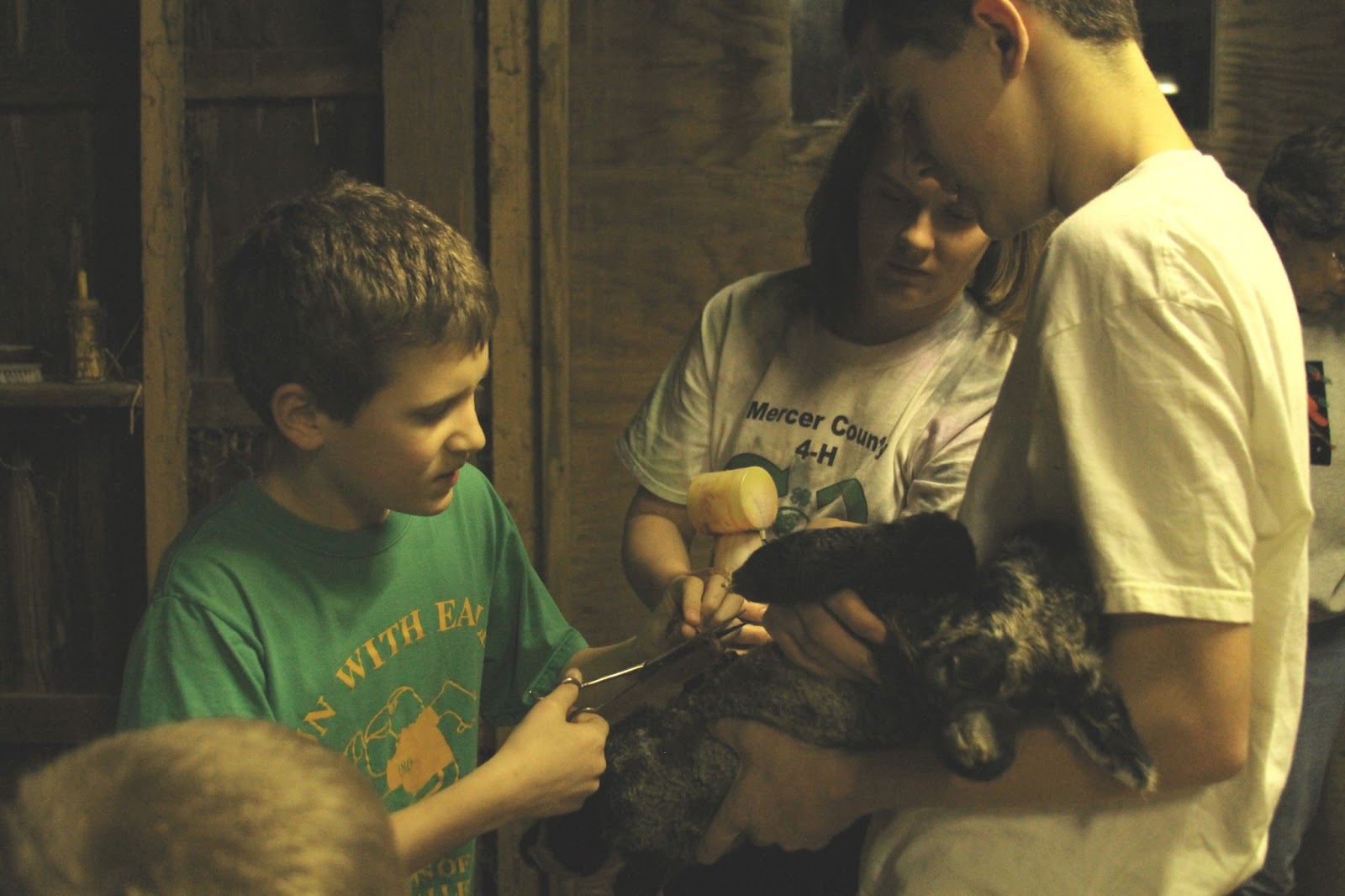
  3. Clip and dip: Using alcohol to sterilize the scissors, we clip the umbilical cord 1-2 inches from the belly. Blunter scissors are preferred because the slight tearing action, as opposed to a sharp cut, helps minimize bleeding. We pour fresh iodine into our dipping cup (any container with a mouth about 2 inches in diameter; a baby food jar works well), hold the cup so it forms a tight seal on the lamb's belly, and then hold the lamb belly-up to soak the area around the umbilicus, so everything is liberally covered with iodine. We do this after weighing so the iodine doesn't rub off on the lamb sling.

  4. Probiotic & selenium E gel: We give each lamb half a dose of both. 

  5. Strip: At this point, we put the ewe in a jug with her lambs. We don't have our ewes lamb in the jugs because there is not enough room for them to move around and change position comfortably. We strip the plugs out of her teats if the lambs haven't done so already. If they have, it's a good sign that they already got their first dose of colostrum. We make sure that all the lambs can find the udder and have latched on before leaving them. We will use a heat lamp if it is really cold and the lambs are having trouble keeping warm, but carefully suspend it above the barn floor and institute frequent checks.

  6. Feed and water: The ewe is given a nice grass hay (no grain or alfalfa) in a hay rack hung high enough that the lambs can't get their heads stuck in it. We also give a bucket of clean, fresh water, tied to the jug with binder twine so it doesn't accidentally get dumped. We used to give molasses water, but found the ewes prefer plain water.

  7. Antibiotic: If we had to assist the ewe in any way, she is started on antibiotics and follow up is provided as recommended on the bottle.

Trimming the umbilical cord; 
our iodine cup is being held in the background, ready for use


We keep a close eye on the ewe and her lambs for the next few days, to make sure the lambs are getting enough to eat and the ewe is not having any problems with her appetite or udder.
  1. The lambs are weighed every day, and the results noted in the barn book, to make sure there is appropriate weight gain.

  2. The temperature of every lamb's mouth is checked with a finger several times a day for the first few days, to make sure they are getting enough to eat and not suffering from hypothermia. A cold mouth requires immediate action.

  3. The lambs are observed closely to make sure they are all getting a turn at the udder, especially if there are more than two. We also watch to see if they stretch when they get up, another sign that they are getting enough to eat.

  4. The ewe's udder is checked by hand the first few days, to make sure no hot spots or hardness is developing that might indicate the onset of mastitis or a problem with the lambs nursing. 
After 48 hours, we let the lambs and ewe out of the jug. Depending on the weather and status of the lambs, we may keep them in the larger area in the barn while letting the other ewes outside for an additional day or two.

Tomorrow: plans for a simple lamb jacket!

Tuesday, February 5, 2013

lambing supplies

All this talk of yeaning lambs and my thoughts have turned to our own flock. Time for me to bring in the lambing supply boxes, go through them, and clean and toss and reorder, to make sure we are ready to go when the time comes in about six weeks.


In case it is helpful to anyone else, I'll share our list. People organize their supplies differently, but because we bring our ewes close to or into the barn to lamb, we keep our supplies in lidded boxes (to keep them clean and grouped together) on shelves in the barn. Some people keep them in bags to make it easy to carry everything out to the field, some people use a plastic tote... Bottom line, the best method of organizing and storing is the one that makes sense for your particular operation.

We have two boxes for lambing time: one for the obstetrical supplies, and one for the lambs. Obviously there is some overlap between the two.

For possible obstetrical issues, we keep the following supplies on hand, and pray we don't have to use them:
  • Bar-Vac CD&T vaccine (stored in refrigerator, given 4-6 weeks before lambing)  
  • LA-200 or preferred antibiotic (stored at room temp in house)
  • Nutridrench                                     
  • 3 & 6 cc syringes        
  • ½” needles
  • Superlube/ Obstetrical lube
  • Prep soap (to clean hands)
  • Obstetrical/exam gloves
  • Calcium Gluconate
  • Dextrose Solution 50%
  • Hydrogen peroxide
  • Udder balm
  • Lamb puller
  • Book on lambing/kidding positions (Laura Lawson, Managing Your Ewe)

For managing the lambs:
  • Iodine/Triodine
  • Naval dip cup for iodine
  • Alcohol
  • Scissors
  • Suction bulb
  • Probiotic paste           
  • Selenium E Gel
  • Vitamin B injectable
  • Feeding bottle
  • Pritchard nipples
  • Stomach tube
  • Stomach syringe
  • Clean baby food jar (to milk into)
  • O-rings
  • Elastrator
  • Lamb sling
  • Weighing scale
  • Thermometer
  • Dried colostrum
  • Milk replacer/goat’s milk
  • Blow dryer
  • Clean towels
  • Heat lamp
  • Lamb coats (cold weather)
  • Book on lamb issues (Laura Lawson, Lamb Problems)
Most of the items on the lamb list we do need, whether we are having problems or not, because we use them to care for all the lambs after they are born. I will go into that procedure tomorrow!

Monday, February 4, 2013

the big game

It probably comes as no surprise: I am not a huge football fan. Despite my best efforts over the past 30 years or so I really don't understand all the arcane rules. Well, not really my best effort, more like a half-hearted attempt to make the men in my life happy, because honestly I have a hard time caring.

As more and more findings come to light about the damage the game does to players' brains, my feelings have cooled even more. Now it is akin to watching a time-delay blood sport. Witnessing grown men subject themselves to a high probability of catastrophic injury or degenerative brain damage for my viewing pleasure is not my idea of entertainment. Was it just me, or did all those ads by the NFL suggest that the organization is feeling a bit on the defensive?

I caught a few of the commercials, when I wasn't in the other room watching Downton Abbey, and of course there was one that stood out from the rest.


Our entire room was silent while watching this, and I suspect that the commercial had the same effect in the majority of viewing rooms across the nation. The scratchy recording and simple yet beautiful still-frame shots were arresting. The speech by Paul Harvey was recorded at the 1978 FFA National Convention, and the commercial is being promoted in conjunction with the FFA's campaign against local hunger.

There was one phrase that I couldn't quite catch—then I realized the text was printed right below the frame on youtube.
God said, "I need somebody strong enough to clear trees and heave bales, yet gentle enough to yean lambs and wean pigs and tend the pink-comb pullets, who will stop his mower for an hour to splint the leg of a meadowlark."
Yean lambs? All these years with sheep, and that's a new one! Of Middle English derivation, Merriam Webster says it means "to bring forth young [from] sheep or goats." Is it a word that has fallen out of disuse in the last 35 years? Or is its use restricted to certain areas of the US? Or did Paul Harvey find it in a thesaurus and think it made a nice contrast to "wean" (which it does)?

A little less than two months until we start yeaning here (we hope). Paul Harvey's words will probably still be on my mind then, as they were this morning while I did chores. At the very least I will have to drop "yean" into conversation once or twice.

Saturday, February 2, 2013

a cautionary tale

We all know words can come back to haunt you, but Terzo has not learned this lesson. Yet.

At a playdate yesterday, he was doing reverse pull-ups on the kitchen counter. Or maybe it's not called reverse pull-ups. Whatever you call standing with your back to the counter with your hands on it, then pulling your entire body up until your arms are straight. I would call it a broken elbow.

I have no idea where he learned his manners. A barn?

The host's mother was amazed at his talent and strength in this regard, even calling in her husband to witness Terzo's feat. When they asked Terzo how he was strong enough to pull this off, he nonchalantly revealed his secret: hauling water for the sheep.

My LSH was also amazed, because Terzo has never hauled one drop of water for the sheep.


Until today. Lesson learned? I doubt it. How many of us can honestly say that we know when to keep our traps shut?

Friday, February 1, 2013

popularity of penguins

Every so often (OK! almost every day! you got me!), I check out what is bringing people to my little corner of the world—little being the operative word. I want to give the people what they are looking for.

Imagine my surprise to note these statistics, which have been trending pretty true over the last month or so, though no surprise over the actual numbers of the statistics, because my corner of the world is, as previously  noted, a little one:


penguin diorama ideas
8
penguin diorama
6
penguin diorama habitat
5
losing sleep counting sheep
4
tundra dioramas
4
how to make a diorama of a penguin and its habitat
3
early power tools
2
frolicking sheep
2
how to make a diorama penguin
2
lottery ticket basket ideas


Good lord have mercy, there are quite a few people out there desperate for ideas on how to put together a elementary school level diorama project involving some penguins on an arctic tundra. At least I hope it is for elementary school, and not some college final exam.

(In an aside: early power tools? What on earth would bring this blog up for that search? Early knitting tools, maybe...)

By way of reminder, my son's diorama looked like this, because I am a big believer in having an elementary school project look like an elementary school project (in other words, he did most of the work by himself):


Such desperation, and this is what google serves up in their hour of need. A shoebox, a penguin picture background, a couple of plastic figurines and some clay whale tails. Imagine their disappointment, hoping for some serious blog-worthy effort on how to create the world's most A+-worthy penguin diorama, and ending up with a commentary on the rough road that third children must trod upon.

Makes a blogger feel like she had a big opportunity to make a difference in the world, and she completely missed it. Anyone who wants this idea, feel free to take it: a blog on how to make a great diorama of (insert theme here). Charge money for it. You'll make a mint.